
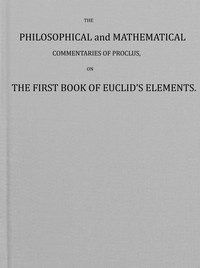
The philosophical and mathematical commentaries of Proclus on the first book of…
Let's be clear: this isn't a novel with a plot in the usual sense. The "story" here is the journey of an idea. Proclus, a head teacher at Plato's famous Academy in 5th-century Athens, picks up the most influential math book of his time: Euclid's Elements. But he doesn't just want to teach the answers. He wants to dig into the big questions behind them.
The Story
Proclus goes through the first book of Euclid's Elements line by line, definition by definition. He starts with basic ideas like what a "point" or a "line" is. But for Proclus, these aren't just dry starting points. He sees them as the foundational principles of all existence. The narrative he weaves is about tracing how abstract, perfect mathematical truths in the mind (like the idea of a triangle) connect to the messy, physical triangles we draw in the sand. He argues that geometry works because it reflects a deeper, divine order. The "conflict" is between seeing math as a practical tool and seeing it as a profound revelation about the nature of reality and consciousness.
Why You Should Read It
This book completely changed how I think about knowledge. It's a powerful reminder that subjects we silo today—math, philosophy, theology—were once part of one big, thrilling conversation. Proclus's excitement is contagious. When he defends a geometric postulate, he's not just being picky; he's protecting a whole worldview where beauty, truth, and goodness are linked. Reading him feels like sitting in on an intense, late-night discussion with one of history's great synthesizers. You see the ancient world not as a collection of facts, but as a living, arguing, deeply curious place.
Final Verdict
This is not for the casual beach reader. It's perfect for the intellectually adventurous—the history buff who wants to go beyond dates and battles, the math or science lover curious about the 'why' behind their field, or the philosophy enthusiast eager to meet a lesser-known giant. If you've ever enjoyed authors like Carl Sagan or Brian Greene who connect science to big human questions, you'll find a fascinating ancestor in Proclus. Be prepared to read slowly and think a lot. The reward is a stunning glimpse into a mind that saw the universe as an intelligible, mathematical, and wondrous whole.
This is a copyright-free edition. It serves as a testament to our shared literary heritage.
Paul Clark
6 months agoWithout a doubt, the atmosphere created is totally immersive. Thanks for sharing this review.



Donna Thomas
1 year agoI stumbled upon this title and it challenges the reader's perspective in an intellectual way. Truly inspiring.